
 Basilian Order of Saint Josaphat


From Anxiety to Watchfulness. Spiritual Growth in the Light of the Teaching of Saint Basil the Great
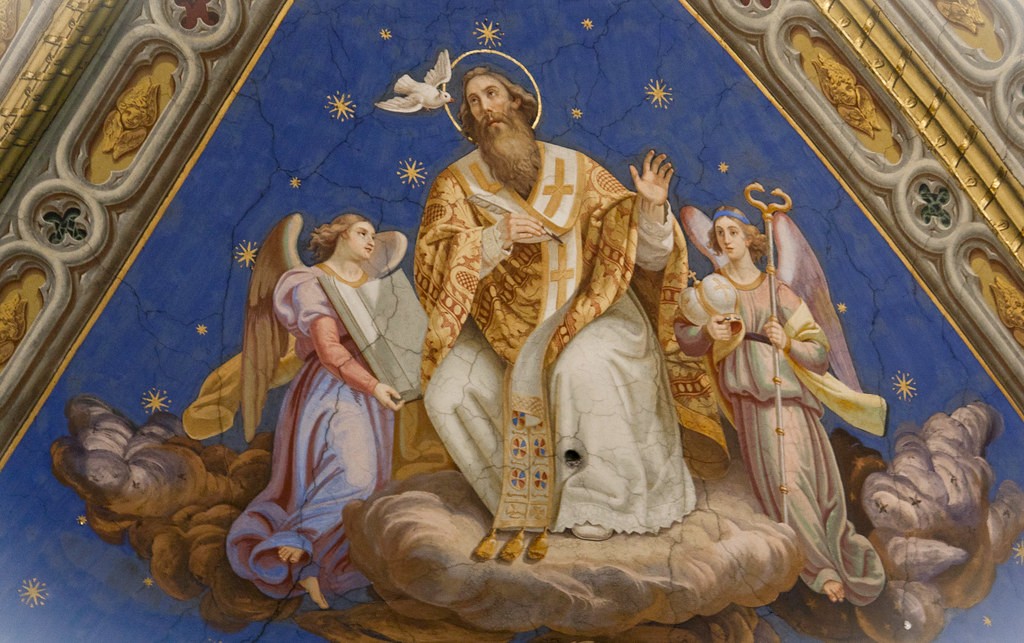
We live in an age of constant stimulation. Notifications, news cycles, responsibilities, expectations, and pressures surround us from morning until night. It is therefore not surprising that many people today struggle with anxiety — racing thoughts, tension in the body, fear of the future, fear of failure, and fear of how others judge us. Often the advice we hear is simple: “Calm down. Breathe. Distract yourself.” While such suggestions may provide temporary relief, they rarely bring deep and lasting peace.
The wisdom of Saint Basil the Great offers something much deeper and more enduring. Writing in the fourth century to monks and Christian communities, he did not deny the reality of inner struggle. He understood well the complexity of the human heart. Yet instead of teaching people to escape anxiety or suppress it, he taught them to transform it — to turn inner disturbance into an opportunity for spiritual growth.
In his Longer Rules, Saint Basil explains that the passions are not natural to the human person but arise when we misuse what God created as good and natural (cf. Longer Rule 2).
This insight is fundamental. The energies within us — zeal, caution, attentiveness, even fear — are not evil in themselves. They are part of the human nature created by God. But when these energies are misdirected, they become disordered passions. What we today call anxiety is often natural concern that has lost its orientation toward trust in God. It becomes energy without peace, attentiveness without surrender.
Instead of immediately treating anxiety as an enemy, we might ask a different question: “Where should this energy be directed?” Toward prayer? Toward responsible action? Toward repentance? Toward accepting what we cannot change?
Anxiety can become spiritually fruitful when it leads us toward clarity and trust in God rather than toward self-condemnation.
Saint Basil also emphasizes spiritual watchfulness. In his ascetical teachings he explains that the Christian must remain attentive to himself and to the condition of his heart (cf. Shorter Rule 203).
This attentiveness — what the Fathers later called nepsis (νῆψις), or watchfulness — is neither panic nor denial. It is calm awareness. When anxiety appears, we do not dramatize it. We simply notice it and bring it before God. Even a short prayer such as: “Lord, order my restless heart” сan become the beginning of interior peace.
One of Saint Basil’s most practical insights concerns our thoughts. He explains that a person is not responsible for the first movement of a thought that arises without our will, but we are responsible for whether we give consent to it (cf. Longer Rule 6).
This teaching is deeply liberating. The first anxious thought is not a sin. A sudden wave of fear is not a failure. These first movements often arise without our choosing them. But what follows is our decision — whether we dwell on the thought and build an entire story around it.
An anxious thought might whisper: “What if everything goes wrong?” If we begin imagining endless worst-case scenarios, anxiety grows stronger. Saint Basil advises that the mind should not be allowed to wander aimlessly but should be gently returned to what is useful and necessary (cf. Shorter Rule 95). Spiritual maturity means learning not to magnify the initial disturbance.
In everyday life this means:
• not repeatedly replaying worst-case scenarios
• not arguing endlessly with fearful thoughts
• returning calmly to the responsibility of the present moment
• directing the mind toward prayer or constructive action
Such discipline develops gradually. Insight alone is not enough; steady practice builds interior stability.
Saint Basil also understood that inner peace is connected to outward order. He structured monastic life around a clear rhythm: times for prayer, work, silence, and rest. Referring to Scripture, he insisted: “Let all things be done decently and in order” (cf. 1 Corinthians 14:40; Longer Rule 37).
Much modern anxiety is intensified by disorder — irregular sleep, constant digital noise, lack of silence, and excessive commitments. Basil therefore teaches moderation and balance. He writes that the body must be cared for as a servant rather than indulged as a master (cf. Longer Rule 17).
This reminds us that body and soul are deeply connected. Proper rest, moderation in food, faithful work, and intentional silence are not merely practical improvements; they are spiritual medicine. When life acquires a holy rhythm, the heart becomes steadier.
For Saint Basil, prayer was never a last-minute emergency tool. In his reflections on the Psalms he describes prayer as a spiritual weapon for those engaged in the struggle of the Christian life.
In the Longer Rules he also teaches that prayer should be continual and not limited only to moments of need (cf. Longer Rule 2). If we pray only when overwhelmed, prayer becomes escape. But when prayer becomes constant and faithful, it strengthens the soul.
The same applies to fasting, reading Scripture, silence, and participation in the Holy Mysteries. These are not emergency buttons; they are spiritual exercises that form interior strength.
At the heart of Saint Basil’s teaching stands trust in God’s providence. In one of his letters he encourages Christians to entrust their affairs to the Lord, who knows what is truly beneficial for us (cf. Letter 2). In his homilies on the Psalms he also emphasizes that nothing occurs outside the providence of God (cf. Homily on Psalm 33).
Much anxiety arises from our attempt to control what lies beyond our power — other people’s opinions, future outcomes, or uncertain circumstances. Saint Basil calls us to clarity and humility: fulfill your responsibility faithfully and entrust the results to God. This surrender is not weakness; it is mature faith.
From Saint Basil’s teaching we can draw clear guidance for everyday life. When anxiety arises, remember that inner energy must be directed rather than destroyed. When anxious thoughts appear, do not give them unnecessary consent. Establish rhythm in daily life. Practice prayer and spiritual discipline consistently, not only in times of crisis. Above all, entrust your life to the providence of God.
Saint Basil formed Christians long before smartphones and deadlines, yet the human heart remains the same. The path to peace has not changed: watchfulness over thoughts, order in life, perseverance in prayer, and deep trust in God.
In this way anxiety is gradually transformed into vigilance, restlessness into discipline, and fear into faith.
Hieromonk Gabriel Haber, OSBM
Selected Bibliography
Basil the Great. Ascetical Works. Translated by M. Monica Wagner. Washington, DC: Catholic University of America Press, 1962.
Basil the Great. The Longer Rules and Shorter Rules. In The Ascetical Works of St. Basil. Washington, DC: CUA Press.
Basil the Great. Homilies on the Psalms. Fathers of the Church Series. Washington, DC: Catholic University of America Press.
Basil the Great. Letters. Translated by Roy J. Deferrari. Cambridge, MA: Harvard University Press / Loeb Classical Library.
Clarke, William K. L. St. Basil the Great: A Study in Monasticism. Cambridge University Press.
Fedwick, Paul J., ed. Basil of Caesarea: Christian, Humanist, Ascetic. Toronto: Pontifical Institute of Mediaeval Studies.
Harmless, William. Desert Christians: An Introduction to the Literature of Early Monasticism. Oxford University Press.
Meyendorff, John. Byzantine Theology. New York: Fordham University Press.


