
 Basilian Order of Saint Josaphat


Monastic Life in the Order of Saint Basil the Great: A Harmony of Monastic Silence and Service
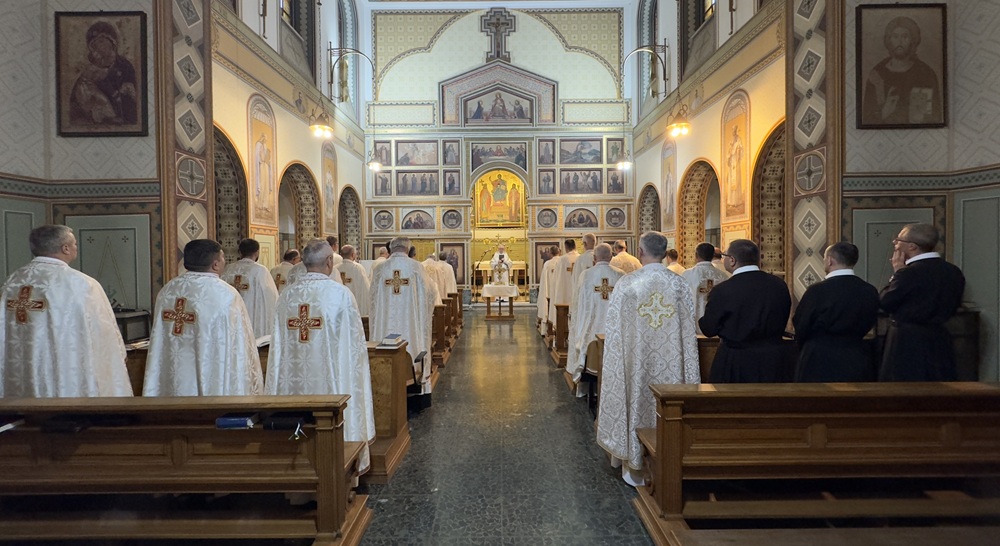
Monastic life is, above all, a choice that transforms a person at the deepest level of his or her existence. It is not simply a change in lifestyle, but a complete inner transformation of the person who responds to God’s call. This choice is not based merely on rational calculation or human logic; it is born from an encounter with God and grows within the life of faith.
In the tradition of the Church, and especially in the teaching of Saint Basil the Great, monastic life is understood as a harmonious union of prayer and service. Saint Basil emphasized that a monk cannot remain enclosed only within an inner spiritual world, but is called to live in community and serve others. For Saint Basil, the silence of the monastery is not an escape from the world, but a source of strength and love that is expressed through concrete acts of service.
For modern young people searching for identity, meaning, and stability, the Basilian model of monastic life offers a new perspective. It provides not only spiritual depth, but also a real opportunity to serve the world through education, pastoral ministry, and social outreach. Monastic life in the Basilian Order is not a withdrawal from reality, but rather a deeper understanding of modern life in the light of the Gospel.
The Gospel Example of Christ — Prayer and Service
When we look at the life of Jesus Christ, we notice a simple yet profound reality: He lived in constant movement between solitude and people. The Gospel tells us that Jesus often “withdrew to lonely places and prayed” (Luke 5:16). Even the Son of God sought silence in order to be alone with the Father — not to escape, but to be renewed and strengthened for service. Without communion with God, even the greatest service loses its meaning.
Yet Jesus did not remain alone forever. After prayer, He returned to the people, teaching, healing the sick, and listening to those who came to Him. In Him there was no separation: His prayer flowed into action, and His action led Him back to prayer. Through His example, Christ showed that true solitude leads to love, and authentic service is born from communion with God.
From the earliest centuries, the Church saw in this example the ideal of monastic life — not an extreme of isolation or activism, but a harmony of both. The Holy Fathers, especially Saint Basil the Great, taught that a monk cannot be closed in on himself, because love for God always leads to love for one’s neighbor. If prayer is genuine, it opens the eyes to the needs of others.
In this sense, monastic life, particularly in the Basilian tradition, follows this evangelical harmony. A monk is called to draw strength from prayer in order to serve others sincerely and sacrificially. Without prayer, service loses its spiritual depth; without service, prayer risks becoming fruitless.
The Basilian Order — Open to the Needs of the Times
From the very beginning, the Order of Saint Basil the Great was never a closed reality separated from people’s lives. On the contrary, its spirituality developed in constant dialogue with the challenges of each age. Basilian monastic life has always sought not only the depth of prayer, but also ways to respond to the concrete needs of the Church. For a Basilian monk, openness to the world is not superficiality, but a sign of living spirituality.
Historically, the Basilians played an important role in education. They founded schools and printing presses and contributed to the growth of culture and intellectual life. This was not simply academic work, but a mission to help shape society, guide people toward truth, and teach responsible living. This mission remains relevant today, when modern society needs not only knowledge, but also moral and spiritual direction.
Pastoral ministry is equally important. Basilian monks serve wherever they are needed: in parishes, youth ministries, missions, retreats, and spiritual guidance. They accompany people, listen to them, support them, and help them discover the path toward God. In today’s world, marked by loneliness and inner confusion, such a presence is especially valuable.
Social service also occupies an important place in Basilian life. Helping those in need, supporting those who suffer, and participating in works of mercy are not additions to monastic life, but natural expressions of it. Love for God is always revealed through concrete acts of love for others.
In today’s world, marked by war, crises, and rapid change, this openness is even more necessary. The Basilian vocation demonstrates that a monk can remain deeply rooted in monastic spirituality while still being fully engaged with the needs of the modern world. A contemporary Basilian monk is called to be grounded in God while remaining attentive to people. This is precisely the evangelical ideal that makes monastic life living and relevant for today’s youth.
Basilian Spirituality — A Union of the Interior and Exterior Life
Basilian spirituality remains alive because it successfully unites realities that at first seem difficult to combine: silence and action, prayer and work, personal communion with God and service to others. This is not merely a theoretical idea, but a way of life formed over centuries and tested through the experience of many generations of monks.
At the center of Basilian monastic life stands community. A Basilian monk does not live alone, but with his brothers, sharing prayer, work, and daily ministry. This is not always easy, yet it is precisely here that love of neighbor, patience, and responsibility are formed. The monastic community becomes a place where faith ceases to be merely words and becomes concrete action.
Another essential element is prayer. In a Basilian monastery, prayer has its own rhythm and central place: the Divine Liturgy, the liturgical offices, personal prayer, and spiritual reading. Prayer is not an addition to life, but its center and foundation. It keeps the monk united with God and gives meaning to everything else he does.
At the same time, Basilian spirituality does not stop at interior life. It naturally flows into apostolic service — pastoral ministry, work with youth, education, preaching, and charitable outreach. A Basilian monk does not shut himself away from the world, but goes out to people, bringing them the gifts he himself has received from God in prayer.
This harmony of community, prayer, and service gives life its wholeness. It prevents the extremes of activism without God or selfish isolation without love for others. Each element supports the other and creates balance.
Modern people are often torn between many roles, responsibilities, and inner desires. The Basilian way of life shows that it is possible to live with integrity — to cultivate prayer, live in community, and carry out a mission at the same time. For this reason, Basilian spirituality today does not sound outdated, but deeply alive. It speaks to young people as a realistic invitation to live more deeply, to live together and for others, and to unite all of this within a single vocation.
Basilian Life — Relevant for Young People Today
Modern society is marked by speed, information overload, and endless choices. On one hand, there are countless opportunities; on the other, there is deep confusion and exhaustion. In this context, Basilian spirituality offers a calm yet powerful response. It does not propose an escape from reality, but a path toward inner balance and meaning.
One of the greatest needs of today’s world is silence. Young people are often overwhelmed not only by external noise, but also by inner restlessness. Basilian life teaches people to enter silence not as emptiness, but as a place of encounter with God. It is there that a person begins to understand himself, his desires, and his vocation more clearly.
Another essential need is community. Despite countless social connections, many young people experience loneliness. The Basilian community offers a different experience: shared life, mutual support, and responsibility for one another. Here a person learns not only to be himself, but also to live for others.
A third need is mission — the desire to do something meaningful and to know that life has purpose. Young people today seek more than employment or activity; they seek meaning. Basilian spirituality responds to this longing through service in the Church, among people, and through concrete acts of love. It is a path where faith becomes action.
For this reason, Basilian spirituality remains deeply relevant today. It unites solitude, community, and mission into one harmonious whole and demonstrates that it is possible to live with God without losing connection to the world. For a young man or woman, this is not simply a theory, but a genuine invitation to discover God, oneself, and one’s place in the world.
Conclusion
Monastic life in the Order of Saint Basil the Great reveals itself as a path of wholeness and integration. It does not divide the person into “interior” and “exterior,” but unites prayer and service into one living experience. The silence of the monastery becomes not an escape, but a source of strength from which love for others is born. For this reason, the Basilian vocation responds not only to humanity’s spiritual needs, but also to the challenges of the modern world.
For today’s youth, Basilian spirituality offers a real way of life that includes prayer, community, and mission. Choosing monastic life in the Basilian Order responds to the deepest human desires — for silence, belonging, and meaning. In a world that often fragments and divides, this vocation restores inner unity and shows that monastic life truly begins where a person encounters God and gives himself in service to others.
Hieromonk Kypriyan Zeykan, OSBM


